

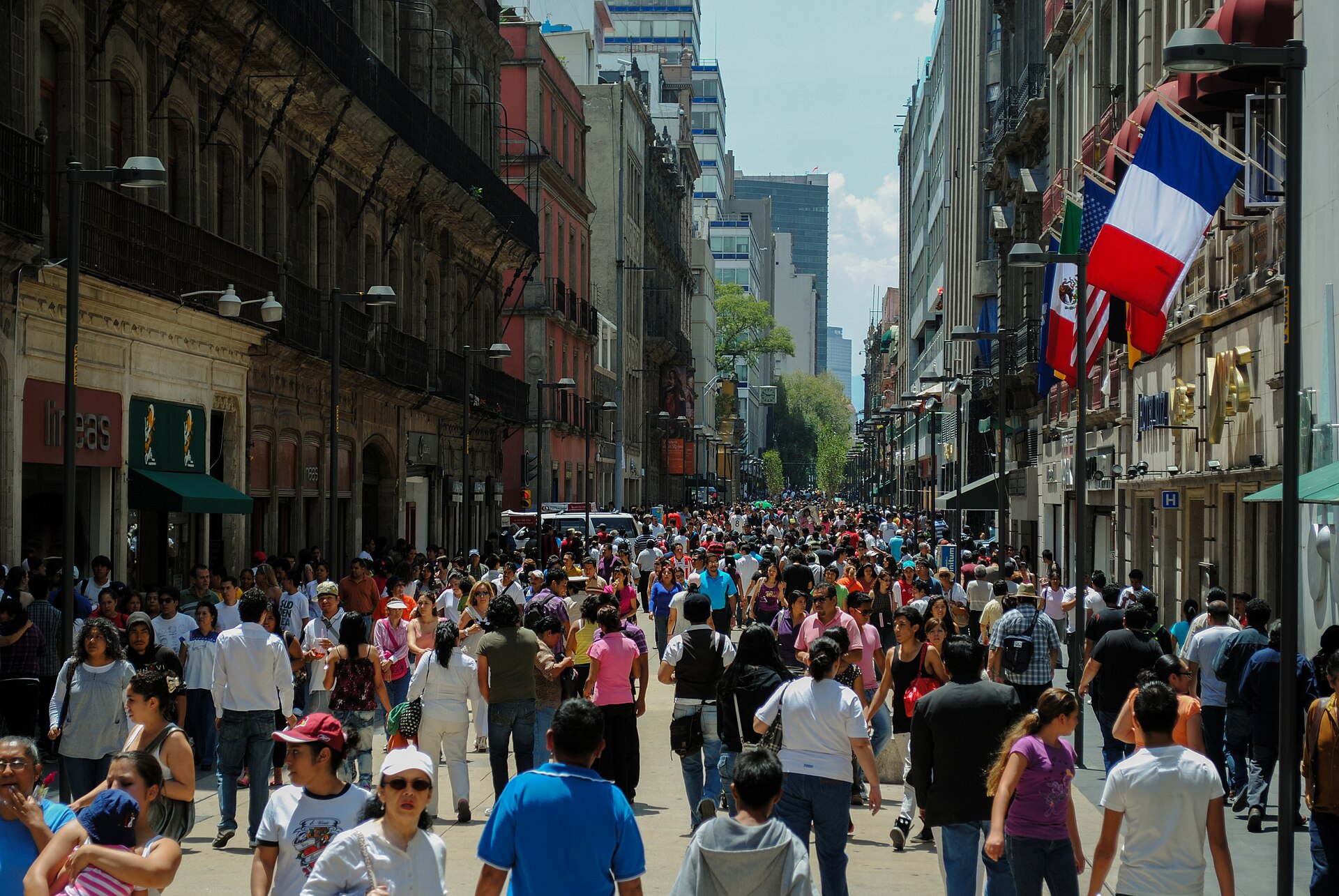
Centro Histórico · Cuauhtémoc, Ciudad de México
Centro Histórico — El futuro se pintó aquí
Seis capas en una tarde: el agua que hundió la ciudad, las piedras que quedaron arriba y los dos frescos que pintaron el porvenir en un edificio del Eje Central.
Referencia de tres horas: incluye la visita al interior del Palacio de Bellas Artes. Sin el interior, el circuito baja a unas dos horas veinte.
Ciudad de México no borra: superpone. Cada capa —el agua, la piedra, el mural, el tender— deja su marca sobre la anterior sin taparla del todo. Este recorrido empieza en el Zócalo, sube por el corredor del agua, entra al Palacio de Bellas Artes y sale por la Alameda, para terminar entre puestos de artesanías y una pastelería de barrio. Y termina donde empezó, que es la mejor manera de mostrar que la ciudad no es una sola época.
- El recorrido no tiene una duración garantizada. La referencia de tres horas cuenta el interior del Palacio de Bellas Artes; con visitas y pausas, realístic se acerca a las tres horas veinte.
- El Museo Palacio de Bellas Artes abre de martes a domingo, de 10:00 a 18:00. La fachada estaba en restauración en 2026: confirma el acceso y el estado de los murales.
- El Museo Mural Diego Rivera es una extensión opcional con boleto, no una parada del circuito base.
- La Plaza del Artesano abre de lunes a sábado y cierra los domingos. La Pastelería Ideal abre todos los días desde temprano.
- El acceso a los recintos con control cambia según el día: confirma horarios antes de salir.
Hay algo debajo
The origin under the city
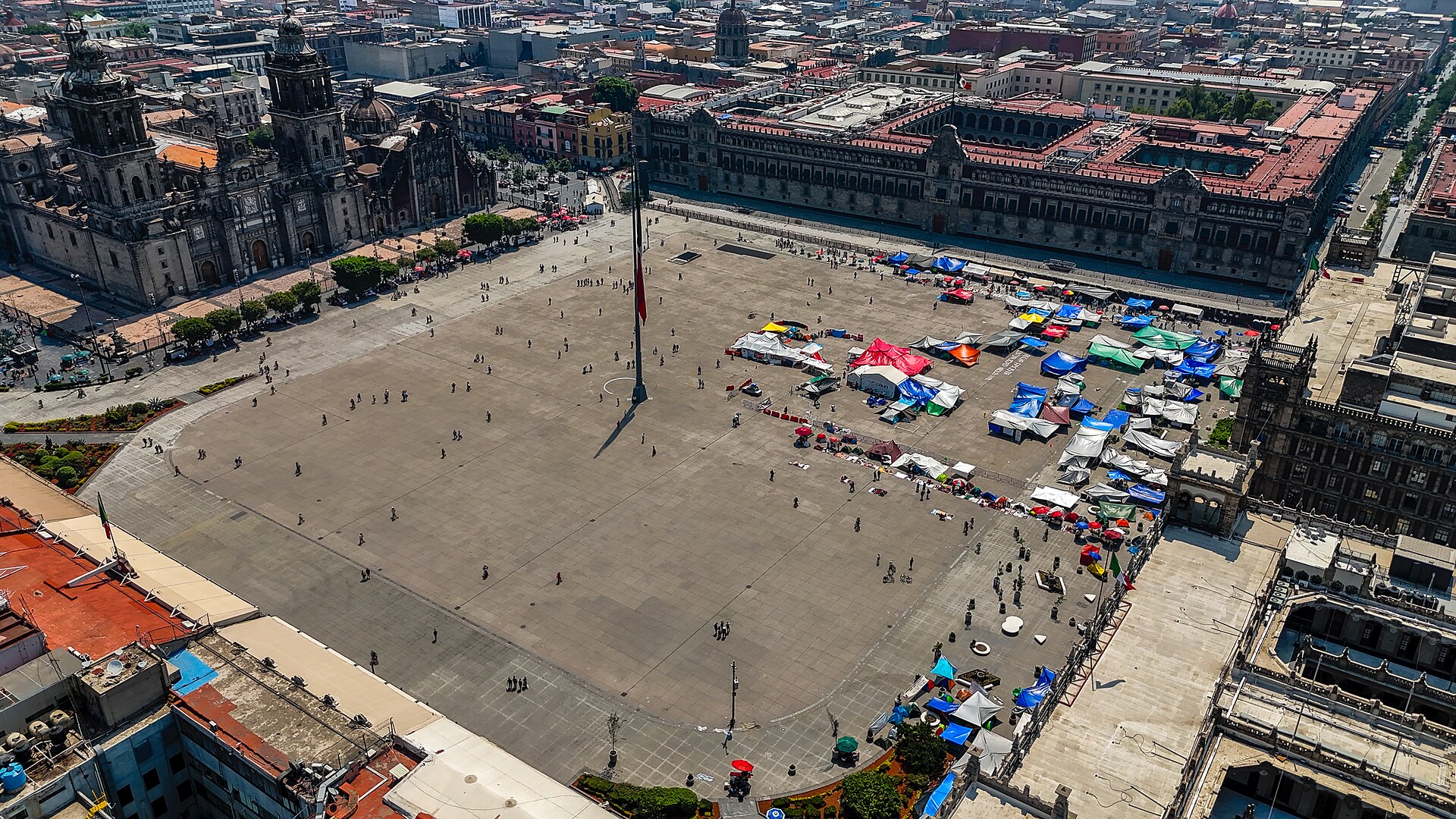
Zócalo y borde de la zona arqueológica
≈ 20 min in this moment
The Zócalo is the most walked-on surface in the city and, at the same time, the one that hides the most layers. Under the flagstones there is an older city: a political and religious centre, a system of dikes and canals, and a city that sank under its own feet. This walk starts by looking down.
The square and the edge
Before going into the archaeological zone, it is worth staying at the edge and looking at the ground. The plaza is a platform built on fill: it was not always at street level. In that thickness, the high part and the low part can be read at a glance, and that difference in level is the first clue that there was water under here.
Qué observar
- The level difference between the plaza and the archaeological edge
- The traffic and the stalls that are set up and taken down on the same flagstones
- The horizontal scale of the square against the vertical one of the National Palace
A political and religious centre
The balcony called La Aguilita
Baja hacia el sur por el corredor que conecta con la Merced.

Agua, urbe y suelo
The city of water and its transformations
Salto del Agua, corredor de Madero y Casa de los Azulejos
≈ 30 min in this moment
Water is not a separate subject here: it is the subject. It shaped the old city, made it vulnerable, and its slow loss is transforming it again. Walking the Eje Central and the Madero corridor is walking two hundred years of that relationship in a single afternoon.
Where the water arrived
The Salto del Agua fountain stands where the aqueduct that brought water from Chapultepec to the city ended: the great domestic work of the viceregal period, built after the Spanish destroyed the previous system. The original fountain, from 1779, is kept in Tepotzotlán, in the State of Mexico; what stands in the city is a version of it. It is a physical reminder of something you cannot see: the water arrived from the west, by gravity, with a drop.
Qué observar
- The spout of the fountain and the place where the water comes up
- Casimiro Castro lithograph of the same fountain, over a century ago, in CREDITS
A river that became an avenue
Madero: the street that was invented
Sigue por Madero hasta el Palacio de Bellas Artes.


El momento central
The Future Was Painted Here
Interior del Palacio de Bellas Artes
≈ 60 min in this moment
Two giant frescoes from the same year, on the same floor, at opposite ends of the building. One was painted by a Mexican in New York for a skyscraper, and brought back censored. The other was painted here, and talks about machines, war and crowds. The argument they opened is still open, and it does not look unlike ours.
Operational note. El Museo Palacio de Bellas Artes abre de martes a domingo, de 10:00 a 18:00. La fachada estaba en restauración durante 2026 y el acceso interior puede variar. Confirma el día de la visita. Si el interior no está disponible, este momento se puede recorrer por fuera: la fachada, la clave en forma de cabeza de guerrero águila y la escala del edificio.
A commission from New York, a censorship and a journey
The painting was not made in Mexico. It was commissioned in 1933 for the Rockefeller Center in New York, where it was censored for the portrait of Lenin, and it was destroyed. Rivera remade it here, in the Palacio de Bellas Artes, and this time he added Trotsky and Marx, who were not in the original. A work that looks Mexican by its location was born from an American commission and a censorship. That is already an argument about who decides what gets represented.
Qué observar
- The portrait of Lenin in the left panel: what had to be erased in New York
- The machine, the energy and the work at the centre of the composition
- The cars, the plane, the cell: the objects of modernity, drawn in detail
Katharsis: war, machinery, the masses
They are not facing each other
Sal por Eje Central y cruza a la Alameda.


Once shown, they cannot be folded back without reloading the page.
Descubrimientos
Separate lo que la historia documenta de lo que el lugar cuenta. Abre cada tarjeta para leerla; ninguna esconde información que necesites para seguir el recorrido.

Módulo opcional
Donceles y su entorno cultural
Una extensión de unos 50 minutos para quien tenga más tiempo o le interesen la arquitectura, las librerías y los recintos culturales.
A una cuadra al norte de la Alameda, Donceles es una calle trazada hacia 1524 y conocida por su docena de librerías de viejo. Es también un catálogo de arquitectura: churrigueresco, art déco, art nouveau, neoclásico y barroco en la misma cuadra. No es un desvío obligatorio: es una opción para quien quiera alargar el recorrido.
El recorrido arranca en la esquina con Allende, donde está el Palacio Legislativo —que fue Cámara de Diputados y donde Porfirio Díaz renunció en 1911— y sigue hacia el norte entre librerías de viejo y las tiendas de fotografía que también|Marcaron la calle. De camino están el Templo de la Enseñanza, el Colegio Nacional, el Teatro Fru Fru, el Teatro Esperanza Iris y el Antiguo Colegio de Cristo, que hoy alberga el Museo de la Caricatura.
- El Museo de la Caricatura, en el Antiguo Colegio de Cristo: el único recinto de la calle con una obra de arte de peso, y con un mural de Orozco, el mismo artista de Katharsis.
- El Templo de la Enseñanza, uno de los churriguerescos más completos de la ciudad, y el Colegio Nacional, de estilo art déco.
- Las librerías de viejo: de la calle entera, el contenido más evidente. Entrar, recorrer, mirar.
Añade entre 45 y 60 minutos y un desvío de unos 500 metros ida y vuelta. Si el grupo va con prisa, se puede sustituir por veinte minutos más en la Alameda. Verifica la apertura de cada recinto el día de la visita: son espacios con horarios y eventos propios.
Fuentes
Lo que está documentado, contrastado en estas fuentes. Las leyendas y las lecturas de Amaxing van señaladas como tales en el texto.
- Museo del Palacio de Bellas Artes (INBAL) — Horario y ubicación
- MPBA (INBAL) — Katharsis, ficha oficial
- MPBA (INBAL) — Murales, colección permanente
- Museo Mural Diego Rivera (INBAL) — Información al visitante
- INBAL — Museo Mural Diego Rivera: historia del mural y su traslado
- UNAM, Revista Digital Universitaria — La historia del agua y el drenaje del Valle de México
- Portal de Turismo de la Ciudad de México — Guía a pie del Centro Histórico
- Portal de Turismo de la Ciudad de México — Calle Donceles
- Pastelería Ideal — Sucursales (oficial)
- Ortiz-Zamora & Ortega-Guerrero — Evolución del hundimiento de la Ciudad de México, Water Resources Research (2010)
Fotografía y datos
Todas las imágenes provienen de Wikimedia Commons, con licencia libre verificada y crédito individual bajo cada una. La ficha completa está en el repositorio.
Licencias: CC0, dominio público, CC BY 4.0 y CC BY-SA 4.0. Los datos operativos (horarios, direcciones) se verificaron el 2026-10-21: confírmalos el día de la visita.
Support the project
Open donations to keep building. Copy the method you prefer or scan the code. Thank you for powering Calpulli CDMX.
Your contribution goes directly to the team to fund experience improvements.